
In the lighting design of a surgical suite, the goal is to ensure precision, safety, and comfort for both medical staff and the patient. From the temperature in the operating room to the color rendering index, each parameter is regulated to avoid clinical errors, enhance concentration, and improve surgical outcomes.
At Luxes, we adapt our solutions to the standards and recommendations for lighting in surgical suites, following UNE, EN, and ISO regulations that cover everything from luminous performance to thermal, spectral, and microbiological control.
1. UNE‑EN 12464‑1: Lighting of indoor workplaces
This European standard establishes the minimum lighting requirements for critical indoor environments such as operating rooms, ICUs, or advanced diagnostic rooms.
Required parameters in the operating room according to UNE‑EN 12464‑1:
- Illuminance on the surgical table: a minimum of 10,000 lux, recommended between 40,000 and 100,000 lux for precise surgical visibility.
- Ambient illuminance: at least 1,000 lux during the intervention and 500 lux during cleaning or preparation phases.
- Uniformity: ≥ 0.7 in the operating area; ≥ 0.5 in the nearby environment.
- Glare (UGR): ≤ 19 to avoid visual fatigue.
- IRC (Chromatic Reproduction Index): ≥ 90 to differentiate tissues with fidelity.
- Surface reflectance: walls (0.3–0.8); floors (0.1–0.5); work surfaces (0.2–0.6).
- Color temperature: ≥ 4,000 K, ideal for maintaining alertness and reducing color distortions.
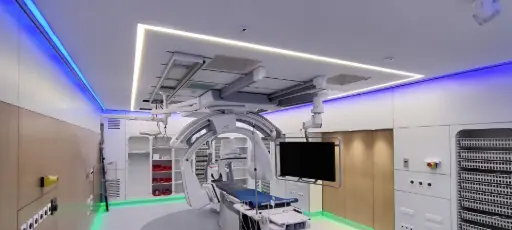
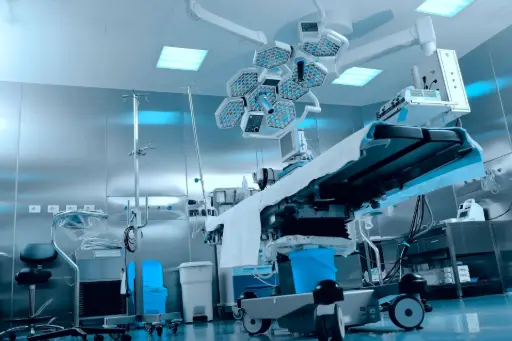
Why does the operating room light not cast a shadow?
Thanks to the multilayer design and circular geometry of surgical lamps, the beams of light converge from multiple angles, eliminating shadows cast by hands or instruments. This property is key in all modern surgical lamps, ensuring continuous and uniform illumination of the operating field.
2. ISO 14644‑1: Cleanroom Classification for Operating Rooms
Surgical rooms are considered hospital clean rooms, and their classification depends on the level of air purity:
- ISO 5–6: operating rooms with laminar flow (transplants, orthopedics, neurosurgery).
- ISO 7: standard operating rooms for general surgery.
- ISO 8: preparation areas, changing rooms, or recovery areas.
This classification implies that operating room lamps must be airtight, with a protection rating of IP65 or higher, without cavities that can accumulate particles, and suitable for intensive cleaning.
3. EN 60601‑2‑41: Specifications for Medical Luminaires
Specific standard for surgical luminaires:
- Central illuminance: between 40,000 and 160,000 lux; minimum guaranteed even in case of failure.
- Depth of field: maintains high light levels with obstructions.
- CE marking and compliance with electrical and optical requirements IEC 60601-1.
This standard regulates both the performance and safety of each surgical lamp in modern operating rooms.
4. ISO/IEC 80601‑2‑60: Thermal and spectral safety
International standard that complements the previous one and establishes:
- Surface temperature < 43 °C, avoiding thermal risk in the operating area.
- UV radiation < 10 µW/lm and IR control: preserves tissues and protects personnel.
- CRI ≥ 90 and color temperature between 3,500–5,000 K.
- Controlled flicker (Pst ≤ 1) to avoid prolonged eye strain.
These conditions ensure a visually comfortable and biologically safe surgical environment.
5. CTE – DB HE3: Energy efficiency in operating rooms
Spanish regulations on lighting efficiency in healthcare buildings:
- VEEI (W/m² per 100 lux): formula = (Power × 100) / (Area × Em).
- Requires regulation with sensors, timing, and maximum use of natural light.
- Optimize consumption without compromising light quality.
Essential technical supplements
- Surgical lighting depth: maintained according to multilayer optics.
- Balance between CRI, UGR, lux, and color temperature: a design without proper compensation can harm visual comfort or performance.
- Reflective materials in the surgical environment: maximize efficiency and reduce fatigue.
Regulatory and Technical Summary
| Regulation | Key aspects |
|---|---|
| UNE‑EN 12464‑1 | 40,000–100,000 lux; CRI ≥ 90; UGR ≤ 19; uniformity and reflectance |
| ISO 14644‑1 | ISO classification 5–7; surgical environmental cleaning; IP65 lighting |
| EN 60601‑2‑41 | Iluminancia 40 000–160 000 lux; seguridad eléctrica y óptica |
| ISO/IEC 80601‑2‑60 | Temperatura superficial < 43 °C; espectro seguro; CRI ≥ 90 |
| DB HE3 – CTE | Efficiency control through VEEI; lighting regulation and control systems |
This regulatory and technical compendium is present in the development of all Luxes systems for operating rooms and critical care areas. From the definition of the color spectrum to the selection of each surgical lamp, everything is designed to provide a precise visual experience, without shadows, and energy-efficient..
Do you want to know how Luxes applies these standards in real operating rooms?
→ View project surgery room Hospital Clínic de Barcelona

- Asociación Española de Normalización (UNE). (2022). UNE-EN 12464-1: Iluminación de los lugares de trabajo – Parte 1: Interiores. Recuperado de https://www.une.org/encuentra-tu-norma/busca-tu-norma/norma?c=N0068596
- International Organization for Standardization (ISO). (2015). ISO 14644-1: Cleanrooms and associated controlled environments – Part 1: Classification of air cleanliness by particle concentration. Recuperado de https://www.iso.org/standard/53394.html
- International Electrotechnical Commission (IEC). (2022). IEC 60601-2-41: Medical electrical equipment – Part 2-41: Particular requirements for the basic safety and essential performance of surgical luminaires and luminaires for diagnosis. Recuperado de https://webstore.iec.ch/publication/66955
- ISO & IEC. (2017). ISO/IEC 80601-2-60: Medical electrical equipment – Part 2-60: Particular requirements for the basic safety and essential performance of dental equipment. Recuperado de https://www.iso.org/standard/68171.html
- Ministerio de Transportes, Movilidad y Agenda Urbana. (2023). Código Técnico de la Edificación – Documento Básico HE3: Eficiencia energética de las instalaciones de iluminación. Recuperado de https://www.codigotecnico.org/index.php/menu-he/