
To understand how the correct lighting should be in a medical consultation, it is very important to know that it must be different depending on the area of medical care, both in terms of lumens and color temperature or type of lighting fixture used.
In this article, four types of lighting are distinguished according to the area and the regulations that must be applied:
Lighting in reception and admission areas for medical consultations
The lighting in the medical consultation reception areas aims to create a welcoming and comfortable environment for patients, while also providing optimal conditions for the administrative tasks of the staff.
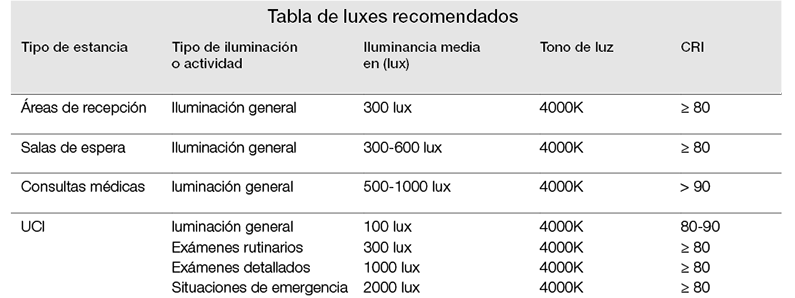
According to the UNE-EN 12464-1 standard, which establishes the lighting requirements in workplaces, the recommended lux levels for areas serving the public would be around 300 lux.
While, to ensure a faithful reproduction of colors, which is especially important in healthcare environments, it is recommended to use light sources with a CRI of 80 or higher. This ensures that colors are perceived naturally, thus facilitating management tasks and generally improving the space.
Regarding the color tone, there should be a balance between the warmth and coolness of the light. It is advisable to use a neutral color temperature, around 4,000 K, contributing to a professional and welcoming environment.
Lighting in waiting rooms for medical consultations
The lighting in medical consultation waiting rooms aims to help reduce patient anxiety and promote a positive experience during the wait. Additionally, good lighting installation facilitates orientation and safe movement within the space.
Through current regulations, suggested illuminance levels for waiting areas in healthcare centers range from a minimum of 300 lux to a maximum of 600 lux.
Regarding the precise perception of colors and the color temperature that should be used, it is recommended to use light sources with a CRI of 80 or higher, while the light tone would be around 4,000K.
Lighting in medical consultations
The lighting in a medical consultation should be designed to minimize eye strain for the staff and promote accurate clinical observation. Well-designed lighting enhances the professional's concentration and instills confidence in the patient during the care process.
It is recommended that light levels range between 500 and 1,000 lux, depending on the type of activity being performed. Tasks that require greater visual detail should have more intense lighting within that range.
It is advisable to use LED lighting with a CRI above 90, which allows for greater fidelity in distinguishing colors, something essential in the clinical field for accurately assessing the appearance of the skin, lesions, or visible symptoms.
Regarding the color hue of the fixtures, it is similar to the previous areas, recommending a neutral light tone, around 4,000K, to provide balanced lighting that enhances visual comfort and accuracy in medical tasks.
Lighting in intensive care units
The lighting in ICUs should facilitate detailed and continuous observation of patients, allowing medical staff to perform diagnoses and procedures with high precision. Additionally, appropriate lighting contributes to the comfort and recovery of patients, creating a less stressful environment.
Within the intensive care units, we distinguish different rooms where the lighting must vary depending on the activity being performed; among these rooms, we find.
- General lighting: to ensure a stable and comfortable environment throughout the room, the UNE-EN 12464-1 standard establishes a minimum lighting parameter of 100 lux.
Regarding the Color Rendering Index, a CRI of between 80 and 90 is recommended, while the color temperature suggests a light source with a neutral tone, around 4,000K.
- Iluminación de la cama: como se ha dicho antes, dependiendo la actividad o la situación, los requisitos de iluminación cambiaran. En exámenes rutinarios, se buscará una cantidad de luz de 300 lux para una correcta evaluación del paciente. En exámenes detallados, se recomienda aumentar hasta 1000 lux, mientras que para situaciones de emergencia es muy aconsejable llegar hasta los 2.000 lux para facilitar intervenciones críticas.
Regarding the perception of colors and the tone of light, it will be the same as the general lighting, that is, a CRI of 80 or higher and a temperature of 4,000K.
Recommended Lux Table
Regulatory and Technical Summary
Este compendio normativo y técnico está presente en el desarrollo de todos los sistemas de Luxes para consultas médicas. Desde la definición del espectro de color hasta la selección de cada luminaria, todo se diseña para crear un entorno luminoso equilibrado y confortable, que favorezca el bienestar del paciente, reduzca la fatiga visual y genere una sensación de calma y confianza, sin comprometer la precisión clínica ni la eficiencia energética.